Bharath K · Python, Data & AI Engineer
I build data pipelines that process broadcast TV at scale.
Python, Data & AI Engineer. Queue-driven ETL on Azure by day, full-stack products and AI systems shipped solo by night.
Work — Data Engineering
Broadcast Ad-Intelligence Pipeline
The problem
Classifying ad occurrences across broadcast TV means ingesting tens of thousands of records per job, continuously, without losing or double-processing a single one.
What I built
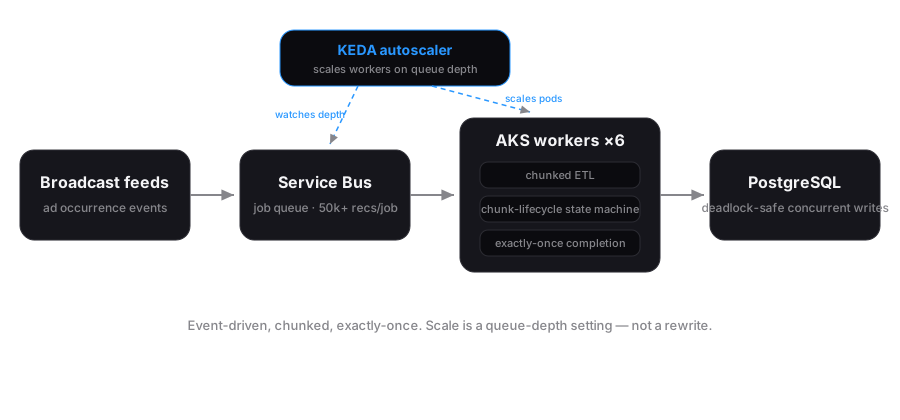
- Event-driven pipeline on Azure: AKS workers fed by Service Bus queues, autoscaled by KEDA on queue depth.
- Chunked ETL at 50k+ records per job, with a chunk-lifecycle state machine guaranteeing exactly-once job completion.
- Deadlock-safe concurrent writes to Postgres from six parallel workers.
Outcome
I moved a live pipeline from SQL Server to Postgres without stopping it. Jobs that stalled under load now complete predictably, and scale is a queue-depth setting instead of a rewrite.
What I'd do differently now: I'd instrument chunk-level tracing from day one — most of the hard debugging was reconstructing what a worker did after the fact.
Python · Azure AKS · Service Bus · KEDA · PostgreSQL
Shipped Product — Full Stack
Attendance Platform for a Construction Firm
The problem
A construction firm needed to know who was actually on site — paper registers and honor-system check-ins weren't cutting it across distributed job sites.
What I built
- React Native (Expo) app with GPS check-in and dual-camera capture, so a check-in proves both location and presence.
- Flask + PostgreSQL backend on AWS EC2 with live route tracking and an admin dashboard.
- The whole path from idea to domain to deployed backend to Play Store release pipeline — solo.
Outcome
End-to-end ownership: one person took a business problem to a product that field crews use daily. That full path is rarer than any framework skill.
What I'd do differently now: I'd put the API behind a managed load balancer and set up staged rollouts earlier — hotfixing a live field app over SSH is not a release process.
React Native · Expo · Flask · PostgreSQL · AWS EC2
Side Venture — Automation & AI
Automation Systems for Small Business
The problem
Small businesses lose customers in the gaps: missed appointment requests, no review follow-ups, questions that never get answered.
What I built
- n8n + WhatsApp (WAHA) workflows: appointment booking, review follow-ups, and RAG chatbots that answer from the business's own documents.
- A Python lead-scraper combining Maps/Places data with site crawls to build qualified prospect lists.
Outcome
I see a business problem and build the whole system around it — not a script, the workflow: intake, response, follow-up, and the data behind it.
What I'd do differently now: I'd productize one vertical instead of custom-building each install — the third bespoke deployment is where a product should have started.
n8n · WhatsApp / WAHA · Python · RAG
How I work
I work in Python and TypeScript, on queues, databases, and LLM pipelines. My default architecture is event-driven: put work on a queue, scale consumers on depth, make every step idempotent. When I add AI, it's grounded — RAG over the business's own data, not a chatbot bolted on.
- Correctness first: exactly-once semantics, state machines for lifecycle, migrations that don't stop the system.
- Ship the whole thing: backend, app, deployment, domain, store listing. Done means in users' hands.
- Plain words over jargon. If I can't explain the pipeline in one sentence, it's too complicated.
Python · TypeScript · PostgreSQL · Azure (AKS, Service Bus, KEDA) · AWS EC2 · React Native · Flask · n8n · RAG / LLM pipelines